Progressive Overload Explained Simply — Stop Plateauing
If your lifts haven’t moved in months, there’s a reason. And it’s probably not your genetics, your protein intake, or the program you’re running.
It’s that you’re doing the same thing every week and expecting different results.
Progressive overload is the fix. It’s also one of the most misunderstood concepts in strength training — not because it’s complicated, but because most people think they’re already doing it when they’re not. This article breaks it down simply and tells you exactly how to apply it starting with your next workout.
What Progressive Overload Actually Is
Progressive overload means consistently increasing the demand you place on your muscles over time.
That’s it. Your body adapts to stress. When you lift a weight your muscles aren’t used to, they respond by getting stronger so they can handle it next time. Once they’ve adapted — once that weight feels comfortable — you have to increase the demand again, or progress stops.
The plateau most people hit isn’t a sign that they’ve reached their ceiling. It’s a sign that they stopped challenging their body.
Progressive overload is the systematic process of making sure that never happens.
The Most Common Way to Do It (And Why People Get It Wrong)
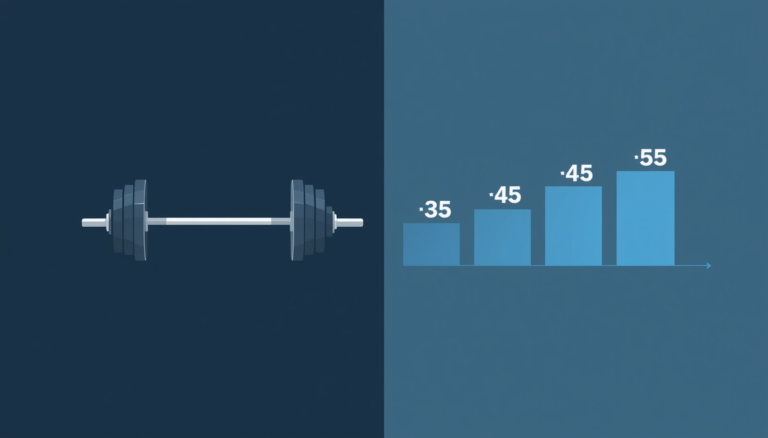
The most obvious form of progressive overload is adding weight to the bar. Do 3 sets of 10 at 135 lbs this week. Next week, do 3 sets of 10 at 140 lbs. Keep going.
Simple in theory. Here’s where people go wrong.
They add weight before they’re ready. They chase the number on the bar instead of earning it with clean reps. They go from 135 to 145 and suddenly their form breaks down, they tweak something, and they’re back to square one.
The rule is this: earn the weight before you add it. If you’re prescribed 3 sets of 8 reps, don’t add weight until you can complete all 3 sets of 8 with solid form. Once you can, add the smallest increment available — usually 5 lbs on each side for upper body, 10 lbs for lower body — and work back up.
That’s how you make progress without getting hurt. Slow and steady isn’t just a cliché here — it’s the actual mechanism.
5 Ways to Apply Progressive Overload (Weight Is Just One)
Adding weight is the most straightforward method, but it’s not the only one. If you’ve been lifting for more than a year, you already know that you can’t add weight every single week forever. Here are all the tools available:
1. Add weight The gold standard. When you can complete all prescribed reps with good form, increase the load. Even 2.5 lbs is progress.
2. Add reps Same weight, more reps. If you’re doing 3 sets of 8, try 3 sets of 9. Once you hit the top of your rep range consistently, then you bump the weight.
3. Add sets More volume at the same weight and reps. Going from 3 sets to 4 sets on a movement is a meaningful increase in total work — even if the weight stays the same.
4. Decrease rest time Same weight, same reps, less rest between sets. Your heart rate stays higher, your muscles recover less, and the session becomes more demanding. This one works especially well for conditioning-focused lifters.
5. Improve range of motion This gets overlooked. If your squat depth has been half-reps for months and you work your way to full depth at the same weight, that’s progressive overload. You’re asking your muscles to work through a longer range — that’s a harder job.
Most lifters should cycle through these depending on where they are in their training. Newer lifters can add weight almost every week. More experienced lifters might spend a month adding reps, then a month adding sets, then bump the weight.
The Double Progression Model — The Simplest System That Works
If you want a dead-simple framework that handles most of the decision-making for you, use double progression.
Here’s how it works:
- Pick a rep range — say, 8–12 reps.
- Pick a starting weight you can do for 8 clean reps but not 12.
- Each week, try to do more reps at that weight.
- Once you can do 12 reps for all your sets with solid form, add weight and start back at 8.
That’s the whole system. Progress reps first, then weight. Repeat indefinitely.
It works because it gives you a clear target every session — you’re either trying to add a rep or you just hit your top of the range and you know it’s time to increase the load. No guessing. No “I feel like going heavy today.” Just a simple, trackable system.
This is what most serious lifters are doing, whether they call it double progression or not.
Why Athletes Plateau (And Why This Concept Should Sound Familiar)
If you’ve played any competitive sport, you already understand progressive overload — you just called it something different.
Think about how practice works. You don’t run the same play at the same speed against the same defense every week and expect to get better. You increase complexity. You go against better competition. You add reps, then add resistance, then add game-speed pressure.
The weight room works the same way. The body doesn’t get stronger from doing what it’s already comfortable with. It gets stronger from being pushed just past that edge, recovering, and getting pushed again.
The compound interest article on this site makes a similar point: small, consistent increases compound into results that look dramatic over time. Progressive overload is that principle applied to muscle. You won’t notice the difference between week 3 and week 4. You’ll notice it at month 6.
How to Track It (Because You Can’t Manage What You Don’t Measure)
This is where most people fall apart. They think they’re progressing because they feel like they’re working hard. But effort and progress aren’t the same thing.
You need to write it down. Every session. Weight, sets, reps — minimum. Most people who’ve been training for years and still look the same have one thing in common: they don’t track anything.
It doesn’t have to be complicated. A note on your phone works. A cheap notebook in your gym bag works. The apps (Strong, JEFIT, RP Hypertrophy) work if you like tech. What doesn’t work is trying to remember what you did last week.
Here’s a basic tracking format:
| Exercise | Set 1 | Set 2 | Set 3 | Notes |
|---|---|---|---|---|
| Bench press | 155 x 8 | 155 x 8 | 155 x 7 | Got 7 on last set — try again next week |
| Squat | 205 x 10 | 205 x 10 | 205 x 10 | Hit all 3 — go to 215 next week |
That second line is the moment. You see it clearly: you hit your target, you know exactly what to do next. No ambiguity.
How Long Before You See Results?
Honest answer: it depends on how long you’ve been lifting.
If you’re new to training (under 1 year), you’re in what’s called the “newbie gains” window. You can add weight almost every week, sometimes every session. Progress will feel fast because your nervous system is adapting rapidly alongside your muscles.
If you’ve been training for 2–5 years, progress slows significantly. You might add weight to a lift once a month. That’s normal and it doesn’t mean you’re doing something wrong — it means you’ve captured a lot of the easy gains and you’re now working for the hard ones.
If you’ve been training for 5+ years consistently, you’re an advanced lifter and overload needs to be planned more carefully — often in structured phases of building, peaking, and deloading. At that point, the double progression model gets supplemented with periodization.
The point is: results compound. A year of consistent progressive overload produces results that look effortless from the outside. Two years produces results that most people assume require elite genetics or pharmaceutical help. It’s almost never that — it’s usually just time and a training log.
The Simplest Version of All of This
Do a little more than last time.
More weight. More reps. More sets. Better range of motion. Less rest. Any of these counts. Pick one, apply it consistently, track it, and repeat.
That’s progressive overload. That’s why it works. And that’s what separates the people who make progress from the people who’ve been doing the same workout for three years and wondering why nothing’s changed.
Your next workout is a chance to do something your body hasn’t done before. Take it.