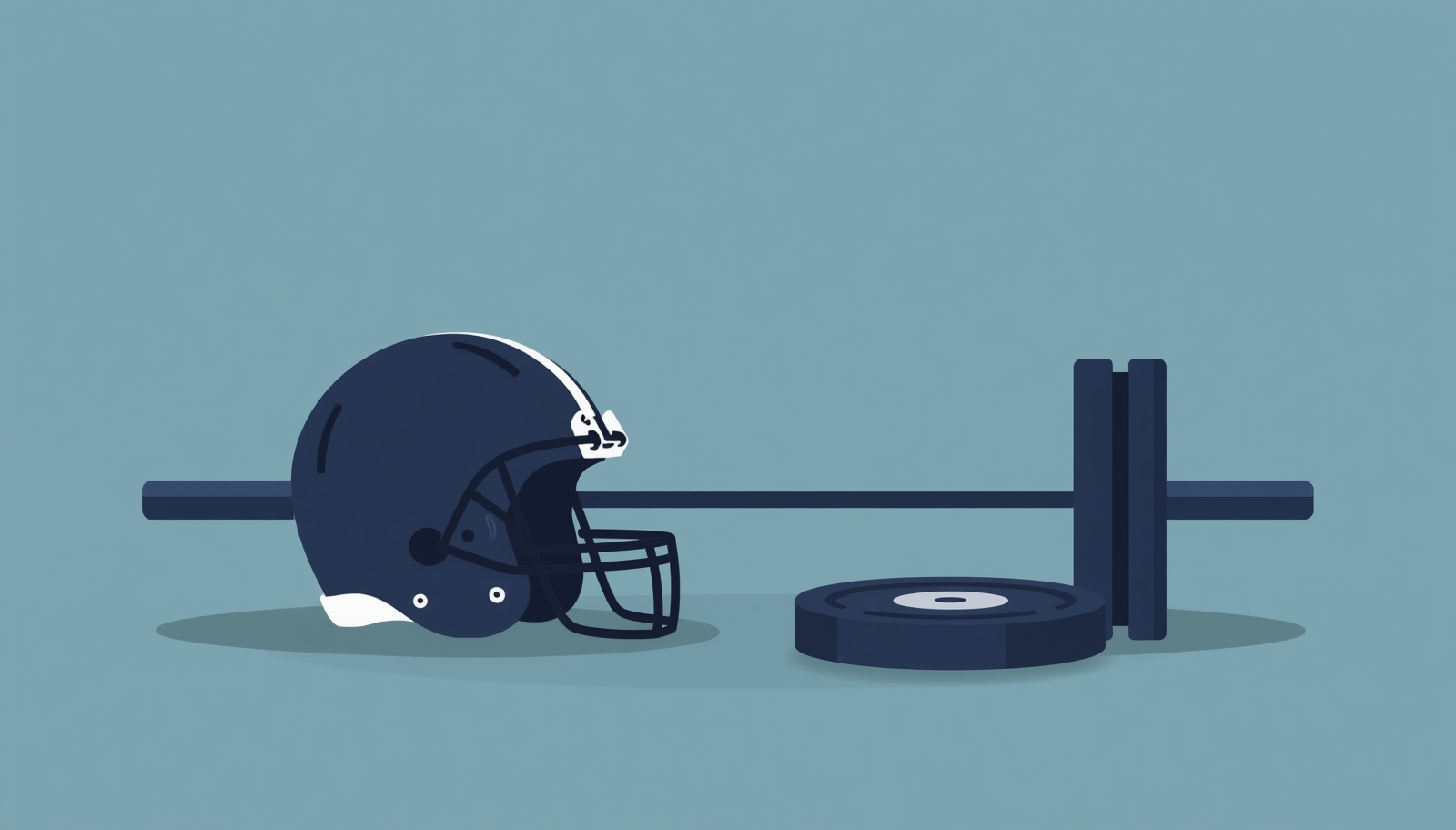
What College Football Taught Me About Training
I played college football without a scholarship.
No free tuition. No stipend. No special treatment in the dining hall. I was there because I wanted to keep competing — and because walking away from the game wasn’t something I was ready to do.
What that experience gave me wasn’t a credential. It was a training education I couldn’t have gotten anywhere else. The lessons didn’t feel significant while I was living them. They do now, a decade later, with a body that still works and a clear picture of what actually matters when you’re building strength for the long haul.
Here’s what four years of college football actually taught me about training.
Lesson 1: Consistency Beats Every Other Variable
The most talented athletes I played with weren’t always the most improved. The most consistent ones were.
When you’re playing without a scholarship, the roster isn’t deep. There’s no next man up waiting if you miss six weeks. You learn quickly that showing up — not perfectly, but reliably — is the foundation everything else is built on.
In the weight room, this meant training when you were tired. Training around soreness. Not skipping because the session wasn’t going to be your best. Over the course of a season, and then a full career, the athletes who trained consistently five days a week at 80% outpaced the athletes who trained brilliantly twice a week and disappeared the rest of the time.
This sounds obvious. It isn’t. Most people optimize for the perfect session instead of the unbroken streak. The streak is worth more.
Lesson 2: The Off-Season Is Where the Separation Happens
In-season training is maintenance. The off-season is where you actually get better.
During the season, you’re managing fatigue, preserving what you built, and staying healthy enough to perform on Saturdays. Real development — the kind that changes what you’re capable of — happens in the months when nobody’s watching.
The athletes in my program who improved the most from year to year were the ones who treated the off-season like a second job. They showed up in January when the building was half-empty and the Midwest winter made it easy to rationalize skipping. They ran conditioning in July when the semester hadn’t started and there was no external accountability keeping them on schedule.
The in-season version of you is a direct reflection of the off-season work you did. You can’t fake it when the games start.
For anyone who isn’t an active athlete anymore, this principle doesn’t go away. The seasons just look different. The “off-season” is every week that isn’t a vacation, a holiday, or a life disruption. That’s when the real work gets done.
Lesson 3: Know What You’re Actually Training For
A lineman and a receiver don’t train the same way. Not because one program is right and the other is wrong — because the physical demands are genuinely different.
Linemen need power from a low center of gravity, contact tolerance, and the ability to sustain effort for a 3-second window dozens of times per game. Receivers need explosive first-step quickness, top-end speed, and fast recovery between sprints. The same training program won’t optimize both.
I watched guys train for outcomes that had nothing to do with their actual needs. A lineman obsessing over his 40 time. A skill player spending half his off-season on max-effort bench press when his real limiting factor was hip mobility and change of direction. Hard work without specificity is just noise.
The question isn’t “am I working hard enough?” It’s “am I working hard enough on the right things?”
For anyone not playing a sport anymore, your position is your goal. Longevity? Power? Fat loss? Conditioning? The specifics of your program should follow from the answer — not from what the person next to you is doing or what’s trending on YouTube.
Lesson 4: Recovery Isn’t Optional — We Just Called It Something Else
We didn’t have sports medicine staffs, float tanks, or cryotherapy suites. What we had was a training room with ice bags and the expectation that you’d be ready tomorrow.
Recovery happened — it was just built into the structure without anyone calling it recovery. Practice schedules had light days. Lifting programs had deload weeks baked in by coaches who’d learned the hard way what happens when you skip them. Sleep was treated as a performance variable, not a luxury.
What I didn’t fully understand until later was how much of the actual training adaptation happens during recovery — not during the session. The workout is the stimulus. Recovery is when your body responds to it.
If you cut recovery short — less sleep, no deload weeks, training through pain instead of around it — you’re not working harder. You’re borrowing from future performance and paying interest on it.
This was the hardest lesson for competitive people to internalize. Rest feels like falling behind. It isn’t. It’s part of the process.
Lesson 5: The Weight Room Reveals How You Handle Adversity
This one’s less about programming and more about character — but it’s real.
A college football weight room is not a comfortable place. You’re asked to do things you don’t want to do, around people who are watching, with coaches who know exactly what you’re capable of and aren’t interested in your excuses.
That environment taught me something about how I respond when things are hard. Whether I look for ways out or ways through. Whether I pace myself to survive the workout or compete against the people around me.
Over four years, I watched that environment reveal a lot about a lot of people. The athletes who competed hardest in the weight room weren’t always the best players on the field. But they were almost always the most reliable — the ones you wanted next to you when the game was close and everything hurt.
That correlation transfers. It shows up at work. In how you handle financial stress. In how you approach anything that’s difficult and important.
The weight room doesn’t just build physical capacity. It builds the habit of doing hard things before you feel ready. That habit compounds over a lifetime.
Lesson 6: Ego Is the Enemy of Progress
This one took me longer to learn than I’d like to admit.
Early in my training, I made decisions based on what looked impressive rather than what would actually make me better. Too much weight with compromised form. Skipping mobility work because it didn’t feel like “real training.” Avoiding movements I was weak at because grinding through something humbling in front of other people isn’t comfortable.
The coaches corrected this the hard way. They didn’t care what you could do on your best day. They cared what you could do consistently, over a full season, under fatigue. That version of performance is built on fundamentals — not highlights.
The athletes who improved the most were willing to be bad at something new in order to get better at something they needed. They could put 135 lbs on a bar and squat to depth while someone next to them squatted 315 with poor form — and not care about the optics.
Ego protects your image. Progress requires you to set the image aside.
This applies directly to training as an adult. The beginner movements are unglamorous. The mobility work isn’t impressive. The deload week feels like quitting. Do them anyway.
What I Carry Forward
I’m not playing football anymore. Haven’t been in a competitive program in years. But I still train 4 days a week, I still track my lifts, and my body still works the way it’s supposed to — which isn’t something every former athlete can say.
Playing without a scholarship didn’t give me a perfect program. It gave me principles that survive contact with real life:
Show up consistently. Do your best work when nobody’s watching. Train for your actual goals, not someone else’s. Recover on purpose. Compete with yourself before you compete with anyone else.
Those lessons didn’t cost a scholarship. They cost four years of showing up to a weight room because the game was worth it.
Turned out to be more valuable than the credential.
Your next move: If you’re a former athlete trying to rebuild a consistent training schedule, start with one thing — pick three days a week and block them in your calendar like a meeting you can’t cancel. Don’t optimize the program yet. Build the habit first. The program matters a lot less than the consistency.
Sources & Data
- NCAA college football participation and non-scholarship athlete data: NCAA.org — College Athletics Participation
- Progressive overload and training adaptation: National Academy of Sports Medicine
- Recovery and training adaptation research: National Strength and Conditioning Association
- Periodization and off-season programming: Journal of Strength and Conditioning Research
Disclaimer: The information on this site is for educational and informational purposes only and does not constitute medical or fitness advice. Always consult a qualified professional before beginning any new training program.