Best Home Gym Setup Under $500 for Serious Lifters
You don’t need a $5,000 setup to train hard at home.
Most people who build home gyms make the same mistake: they either go way too cheap and end up with equipment that breaks or limits their training, or they spend thousands before they’ve done a single rep. Neither is the move.
Here’s the thing — with around $500 and a clear priority order, you can build a setup that handles 80% of what you’d do in a commercial gym. No fluff. No impulse buys. Just the stuff that actually gets used.
This guide is built for people who have trained before and know what they’re doing. If you’re a complete beginner, everything here still applies — you’ll just grow into it faster than you think.
Why a Home Gym Makes Financial Sense
Before we get into equipment, let’s run the numbers, because this is Compete and Compound and we always run the numbers.
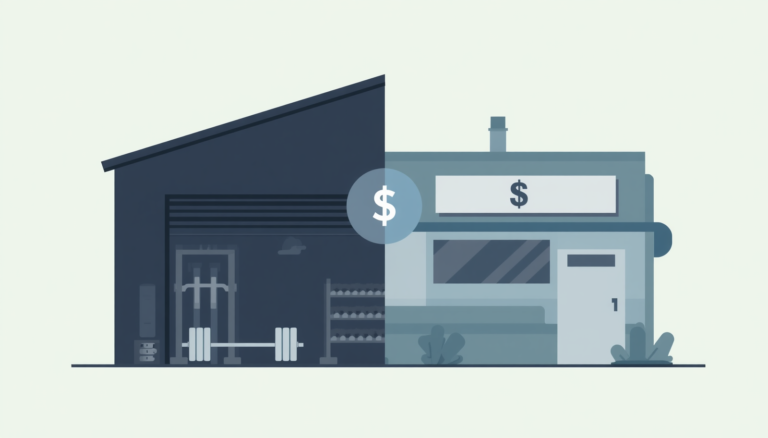
The average gym membership in the U.S. costs $40–50/month, or $480–600 per year. A quality home gym setup at $500 pays for itself in under 12 months — and then the equipment is yours for the next decade.
A $500 gym membership buys you access. A $500 home gym buys you ownership. Ownership compounds. Access doesn’t.
The Priority Order (This Is Everything)
Most home gym advice tries to sell you everything at once. That’s not how this works.
Think of this like building a depth chart. You start with your starters — the equipment you’ll use every single session — and add depth from there. If you’ve got $500 total, here’s how to sequence it:
Tier 1: Non-negotiables (~$280–320) Tier 2: High-value additions (~$100–150) Tier 3: Nice-to-have upgrades (save for later)
Tier 1: The Non-Negotiables
These are the pieces of equipment that make everything else possible. Don’t skip them. Don’t cheap out on them.
1. Adjustable Dumbbells — ~$150–200
This is the single most important purchase for a home gym under $500.
A good set of adjustable dumbbells replaces 15–20 pairs of fixed dumbbells. You can do chest press, rows, curls, shoulder work, lunges, RDLs — basically your entire program — with one set of dumbbells.
The two options worth considering:
Bowflex SelectTech 552 — adjusts from 5 to 52.5 lbs in 2.5 lb increments. Widely available, durable, well-reviewed. Street price around $300–350, but frequently goes on sale or available used for $150–200.
PowerBlock Sport — compact, durable, expandable. Similar price range. Works well if you prefer a more traditional dumbbell shape.
What to avoid: the ultra-cheap no-name adjustable sets under $80. The dial mechanisms break, the weight plates shift mid-rep, and you end up buying real ones anyway. Buy once, buy right.
Where to find them for less: Facebook Marketplace, OfferUp, and Craigslist consistently have used adjustable dumbbells at 40–60% off retail. People buy them with great intentions, use them three times, and sell them six months later. That’s your window.
2. Pull-Up Bar — ~$30–50
Pull-ups and chin-ups are among the highest-ROI exercises you can do. They build your back, biceps, and core, require zero equipment beyond this bar, and transfer directly to athletic performance.
The door-frame style (like the Iron Gym Total Upper Body Workout Bar) runs about $30 and doesn’t require drilling. Mount it in a doorway and you’ve got one of the most effective upper body tools in existence.
If you have ceiling access or exposed joists, a mounted pull-up bar is more stable and allows more grip variations — but the door frame version is plenty to start.
3. Resistance Bands — ~$25–40
Resistance bands are not a substitute for weights. But they are a legitimate tool for:
- Warm-up and activation work (glutes, rotator cuff, hip flexors)
- Banded pushups and rows when you want higher volume
- Mobility and stretching
- Injury prevention work that most people skip
A set of loop bands (light, medium, heavy) runs about $20–30. A set of handled resistance bands with attachments runs a little more. Either works.
Don’t overlook these. After 21 years of lifting, band work for warm-up and shoulder health has become non-negotiable for me before any pressing movement.
Tier 2: High-Value Additions
Once you have the Tier 1 pieces, these are where the next $100–150 goes.
4. Adjustable Bench — ~$80–120
Here’s the honest truth: you can do a lot without a bench. You can do floor press, push-ups, Bulgarian split squats with a chair, step-ups on stairs. But a good adjustable bench opens up a significant range of pressing and row movements that a flat surface can’t replicate.
Look for a bench that adjusts to at least three incline positions and can handle your bodyweight plus the weight you’re pressing without wobbling. The Rep Fitness AB-3000 and the Flybird adjustable bench are both solid options in the $100–130 range.
Avoid the ultra-flat benches with no incline adjustment. They’re a false economy.
5. A Foam Roller or Lacrosse Ball — ~$15–25
Recovery isn’t optional. It’s training.
A foam roller handles larger muscle groups — quads, IT band, upper back, lats. A lacrosse ball gets into tighter spots — glutes, pecs, feet, the area under your shoulder blade that always seems to be tense.
Total cost: $20. Return on investment: not getting hurt, being able to train consistently, and actually feeling recovered between sessions.
If you want one rec: the TriggerPoint GRID Foam Roller. It’s more durable than flat foam rollers and handles more pressure without compressing flat after a few months.
What to Skip (At Least For Now)
A few things that show up in every “home gym under $500” list but shouldn’t be priorities at this stage:
Cardio machines. A treadmill or stationary bike will eat your entire budget and leave you with nothing for actual training equipment. If you want cardio, run outside, do jump rope ($15), or do loaded carries with your dumbbells.
Cable machines or pulley systems. These are great — but they cost $300–500 on their own and you don’t need them to build a complete training program.
Weight belts, straps, and accessories. Not useful until you’re lifting heavy enough to need them. Get the equipment first.
A barbell and plates. A full barbell setup (bar + rack + plates) runs $400–800. It’s the right move eventually, especially for squats and deadlifts. But at the $500 budget level, adjustable dumbbells cover more exercises at a lower cost. Add the barbell when you’ve maxed out what dumbbells can do.
The Full $500 Setup, Priced Out
Here’s what an optimized build looks like when you account for used prices and smart buying:
| Item | Estimated Cost |
|---|---|
| Adjustable dumbbells (used or on sale) | $150–200 |
| Door-frame pull-up bar | $30–50 |
| Resistance bands (set of 3–5) | $25–35 |
| Adjustable bench | $80–120 |
| Foam roller + lacrosse ball | $20–30 |
| Total | $305–435 |
That leaves $65–195 depending on what you find used. Use that buffer for:
- Jump rope ($15)
- Ab wheel ($15–20)
- Extra resistance bands if you want heavier tension
Or save it toward your first barbell and weight plates down the road.
Where to Buy (And Where to Find Deals)
New equipment:
- Amazon for bands, bars, and foam rollers — reliable and fast
- Rep Fitness or Titan Fitness for benches — better quality than what Amazon typically carries in the bench category
- Bowflex directly for SelectTech dumbbells if you want warranty coverage
Used equipment:
- Facebook Marketplace is the first stop for anything heavy (dumbbells, benches)
- OfferUp and Craigslist second
- Play It Again Sports if you have one nearby — they buy and resell used fitness equipment at fair prices
The used market for fitness equipment is excellent right now. COVID-era home gym builds flooded the secondary market, and much of it has barely been touched. If you’re patient and check listings weekly, you can build this entire setup for $250–300.
One More Thing: Space
Before you spend anything, measure your space.
You don’t need much — a 6×8 foot area handles dumbbells, a bench, and most floor work. But knowing your ceiling height matters (pull-up bar), and knowing your floor surface matters (rubber mats protect hardwood and reduce noise on concrete). A set of interlocking rubber floor tiles runs $40–60 and is worth adding once the core equipment is in place.
The Bottom Line
A $500 home gym isn’t a compromise. It’s a starting point that, if you pick the right pieces in the right order, handles nearly every training goal — strength, muscle, conditioning, mobility — without a commute, a membership fee, or waiting for equipment.
Start with the adjustable dumbbells and pull-up bar. Add the bench once you have those. Everything else fills in from there.
Your next move: Check Facebook Marketplace for adjustable dumbbells in your area before you buy anything new. Price them new, then check used. Buy the best set you can find at the best price, and don’t look back.
Sources & Data
- Average U.S. gym membership cost: Statista — Average Monthly Cost of Gym Membership in the U.S.
- Home gym equipment market data: IBISWorld — Gym, Health & Fitness Clubs Industry Report
- Bowflex SelectTech 552 specs and pricing: Bowflex.com
- Rep Fitness AB-3000 bench specs: RepFitness.com
- TriggerPoint GRID Foam Roller: TriggerPoint.com