NIL Taxes: What College Athletes Need to Know
Most college athletes who sign their first NIL deal think about the money they’re getting. Very few think about what they owe the government before they spend a dollar of it.
That’s the mistake. And it’s an expensive one.
NIL income — whether it comes from a brand deal, a social media partnership, an autograph signing, or a local business sponsorship — is taxable income. The IRS doesn’t care that you’re a student. It doesn’t care that you’re not a professional. The moment you receive compensation for the use of your name, image, or likeness, you have a tax obligation.
Fifty-one percent of college athletes who received NIL income reported unexpected tax situations. That number exists because nobody explained this before the check arrived. This article fixes that.
NIL Income Is Self-Employment Income — Here’s Why That Matters
This is the detail most athletes miss, and it changes everything about how your taxes work.
When you receive NIL income, you’re not an employee of the brand paying you. You’re an independent contractor. That distinction has two major consequences:
No withholding. When you work a regular job, your employer withholds federal and state income taxes from every paycheck and sends them to the IRS on your behalf. NIL deals don’t work that way. The brand pays you the full amount — no taxes withheld. The entire tax obligation lands on you.
Self-employment tax. As an independent contractor, you owe self-employment tax on top of regular income tax. Self-employment tax covers Social Security and Medicare — the taxes that employees split with their employer. As a self-employed person, you pay both sides. In 2026, the self-employment tax rate is 15.3% on net self-employment income up to $176,100.
So if you sign a $10,000 NIL deal, you don’t owe taxes on $10,000 minus a standard deduction. You owe self-employment tax on the net amount first, then regular income tax on top of that. The total tax burden on NIL income is consistently higher than most athletes expect — often 25–35% of the gross amount depending on your total income situation.
The Quarterly Estimated Tax Requirement
Here’s where athletes get hit the hardest.
The US tax system is pay-as-you-go. If you’re an employee, your employer handles this automatically through withholding. If you’re an independent contractor with NIL income, you’re responsible for making estimated tax payments to the IRS four times a year.
The 2026 estimated tax deadlines are:
| Payment Period | Due Date |
|---|---|
| January 1 – March 31 | April 15, 2026 |
| April 1 – May 31 | June 16, 2026 |
| June 1 – August 31 | September 15, 2026 |
| September 1 – December 31 | January 15, 2027 |
If you don’t make these payments and you owe more than $1,000 in taxes at the end of the year, the IRS charges an underpayment penalty — essentially interest on the tax you should have been paying throughout the year.
Most college athletes who get hit with a surprise tax bill in April made one of two mistakes: they didn’t know about estimated payments, or they knew but spent the money before the deadline. Both are fixable with the right system.
How Much to Set Aside — The Simple Rule
You don’t need an accountant to figure out a reasonable set-aside amount. Here’s a practical rule that works for most college athletes:
Set aside 25–30% of every NIL payment the day it hits your account.
Move it immediately to a separate savings account — not your checking account, not your spending money. A dedicated “tax account” that you don’t touch until estimated payment deadlines.
Here’s why 25–30% works as a starting point:
- Self-employment tax: ~14.1% (after the deductible portion)
- Federal income tax: depends on your total income, but 10–22% for most college athletes
- State income tax: varies by state — 0% in states like Florida and Texas, up to 13.3% in California
If your total NIL income for the year is under $40,000 and you have no other significant income, 25% is usually sufficient. If you’re earning more, or if you live in a high-tax state, push to 30%.
Overpaying estimated taxes isn’t a problem — you get the excess back as a refund. Underpaying creates penalties and a stressful April. Err on the side of setting aside more.
The 1099 Form — What It Is and What to Do With It
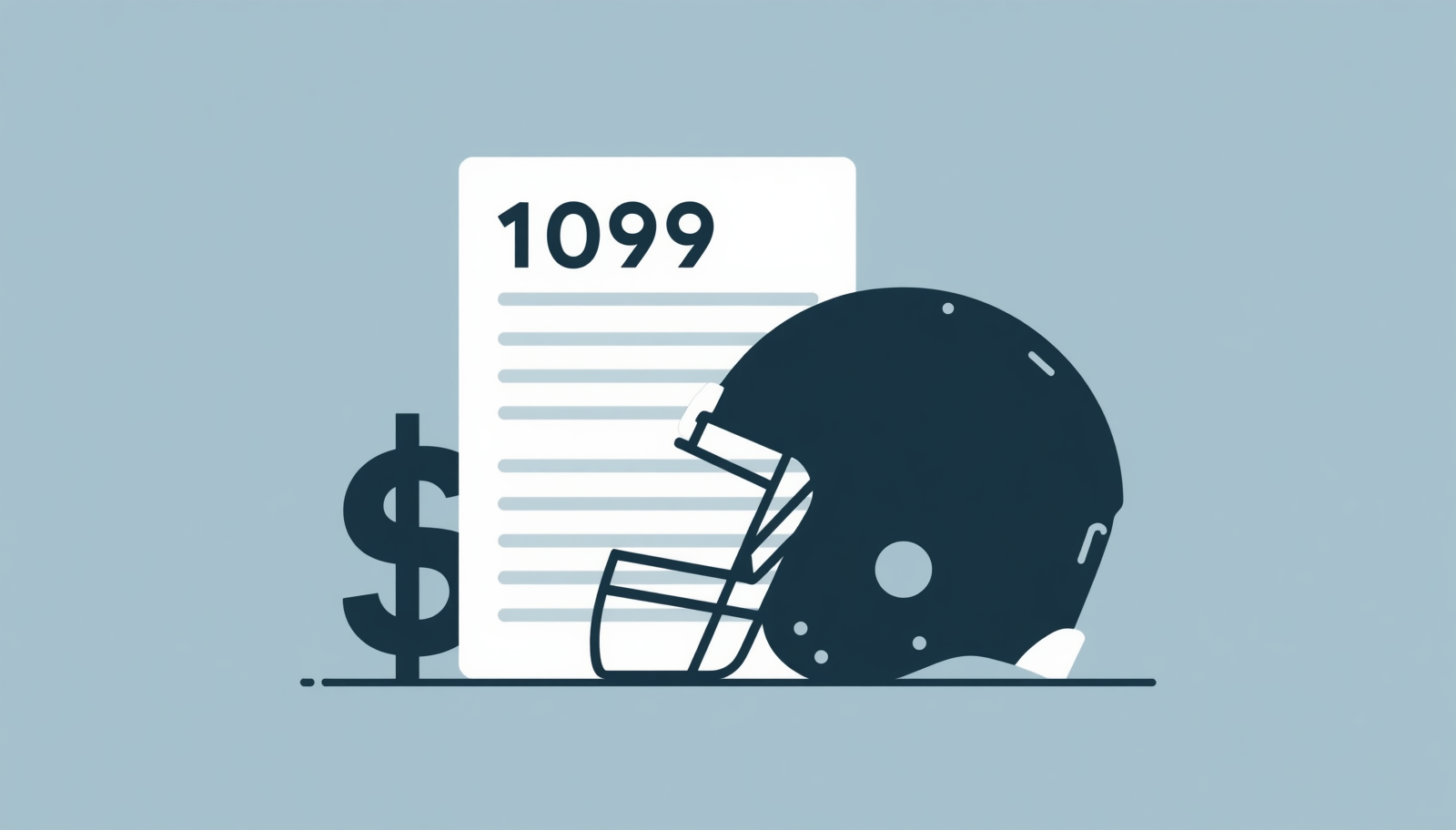
If you receive $600 or more from a single company in a calendar year, that company is required to send you a Form 1099-NEC by January 31 of the following year. This form reports the income to both you and the IRS.
A few things to understand about 1099s:
The IRS already has this information. The company files a copy of your 1099 directly with the IRS. If you receive a 1099 and don’t report that income on your tax return, the IRS will notice the discrepancy.
You may receive multiple 1099s. If you have deals with three different brands, you may get three separate 1099 forms. Each gets reported on your tax return.
Under $600 doesn’t mean tax-free. If a company pays you less than $600, they’re not required to send a 1099 — but the income is still taxable and still needs to be reported. The $600 threshold is a reporting requirement for the company, not a tax-free limit for you.
Keep records of every NIL payment you receive, even the small ones. A simple spreadsheet tracking the date, company, and amount covers everything you need at tax time.
Deductions — What NIL Athletes Can Actually Write Off
Here’s where self-employment status actually works in your favor.
As an independent contractor, you can deduct legitimate business expenses from your NIL income before calculating the taxes you owe. This reduces your taxable income, which reduces your tax bill.
Common deductible expenses for college athletes with NIL deals:
Equipment and gear. If you purchase equipment specifically for NIL content creation — a camera, ring light, microphone, tripod — those are potentially deductible business expenses.
Phone and internet. A percentage of your phone and internet bills may be deductible if you use them for NIL-related business. The percentage needs to reflect actual business use — if 30% of your phone usage is NIL-related, 30% of the cost may be deductible.
Agent or advisor fees. If you pay a sports agent, NIL agency, or financial advisor to manage your deals, those fees are deductible.
Content creation costs. Editing software, design tools, and any other expenses directly related to producing sponsored content may be deductible.
Travel for NIL appearances. If you travel to an appearance, signing, or promotional event for a brand deal, the travel costs may be deductible.
Important: Keep receipts and records for every expense you plan to deduct. The IRS can audit self-employment deductions, and documentation is your protection. A simple folder — physical or digital — where you save receipts as they happen is all you need.
State Taxes — The Variable Nobody Talks About
Your federal tax obligation is the same regardless of where you live. Your state tax situation is not.
Nine states have no state income tax: Alaska, Florida, Nevada, New Hampshire, South Dakota, Tennessee, Texas, Washington, and Wyoming. If you attend school in one of these states and earn NIL income there, you have no state income tax obligation on that income.
If you attend school in California, Oregon, Minnesota, or another high-tax state, your state income tax on NIL income can be significant — California’s top marginal rate is 13.3%, and even lower-bracket rates can add 4–8% to your total tax burden.
There’s also a complexity unique to athletes: if you travel to other states for appearances, signings, or promotional events, you may owe taxes in those states as well. This is called the “jock tax” — it applies to professional athletes and increasingly to college athletes with NIL deals who conduct business across state lines.
If your NIL income is significant and you’re earning it across multiple states, this is the point where a tax professional who understands athlete taxation is worth the cost.
When to Get a Tax Professional Involved
For small NIL deals — a few hundred dollars from a local business or a one-time social media post — you can likely handle your taxes with a standard filing software that includes self-employment income (TurboTax, H&R Block, FreeTaxUSA).
Get a CPA or tax professional involved if:
- Your total NIL income exceeds $10,000 in a year
- You have deals across multiple states
- You have an agent or agency managing multiple deals
- You’re unsure about which expenses are deductible
- You’ve already missed an estimated payment deadline
The cost of a tax professional — typically $200–$500 for a straightforward self-employment return — is almost always less than the penalties and overpayments that come from handling a complex situation without help. And the fee is a deductible business expense.
The Five Things to Do Right Now
If you have NIL income and haven’t set up your tax situation, here’s the exact order of operations:
1. Open a separate savings account today. Label it “Taxes.” Every NIL payment you receive, move 25–30% of it here immediately.
2. Track every payment. Start a simple spreadsheet — date, company, amount. Do this for every payment, even the ones under $600.
3. Track every business expense. Same spreadsheet, second tab. Date, expense, amount, business purpose.
4. Mark your estimated tax deadlines on your calendar. The four dates above. Set reminders 2 weeks before each one.
5. File on time. April 15 is the federal filing deadline for most taxpayers. Extensions give you more time to file — not more time to pay. If you owe money, it’s due April 15 regardless.
If you’re just getting started with NIL deals and want a broader framework for what to do with the money beyond taxes — where to put it, how to invest it, what to prioritize — the NIL money article on this site covers the full picture. And the financial playbook article walks through the investing basics every young athlete should have in place alongside their tax setup.
This article is for informational and educational purposes only and does not constitute financial, tax, or legal advice. Tax laws change frequently and vary by state. Always consult a qualified tax professional for advice specific to your situation.
Sources & Data
- IRS self-employment tax rate (15.3%): IRS.gov, Schedule SE — verify current rate before publishing
- 2026 self-employment tax wage base ($176,100): IRS.gov — verify annually, this figure adjusts each year
- Estimated tax deadlines: IRS Publication 505 (Tax Withholding and Estimated Tax) — verify current year dates before publishing
- 1099-NEC reporting threshold ($600): IRS.gov
- State income tax rates: Tax Foundation state income tax comparison — verify current rates before publishing
- NIL tax situation statistic (51%): verify against most current available survey data before publishing