Dollar-Cost Averaging Explained With a Sports Analogy
The best investing strategy isn’t complicated. It doesn’t require market knowledge, a financial advisor, or perfect timing. It requires one thing: showing up consistently, regardless of conditions.
That’s dollar-cost averaging. And if you’ve ever trained through a bad week, competed when you weren’t at your best, or run conditioning in weather you had no business being outside in — you already understand how it works.
What Dollar-Cost Averaging Actually Is
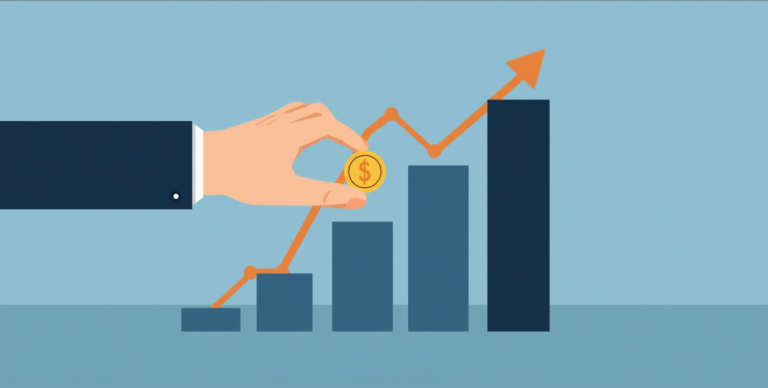
Dollar-cost averaging (DCA) means investing a fixed amount of money on a regular schedule — regardless of what the market is doing.
$300 every month. $75 every week. $1,200 every quarter. The amount and the interval don’t matter as much as the consistency. You invest the same amount on the same schedule no matter what — whether the market is up, down, or sideways.
That’s it. That’s the whole strategy.
In plain English: you’re not trying to predict the perfect moment to invest. You’re removing the decision entirely and letting the schedule do the work.
The Sports Analogy That Makes It Click
Think about how an athlete approaches practice.
A serious athlete doesn’t wait until they feel ready to train. They don’t skip because the weather is bad, because they’re a little sore, or because they had a rough week. They show up on the scheduled days and put in the work — because they understand that results come from accumulated effort over time, not from a handful of perfect sessions.
Dollar-cost averaging works the same way.
You don’t wait for the market to feel right. You don’t sit in cash hoping for a dip. You invest on your scheduled days and let the accumulation do the work — because results come from consistent contributions over time, not from trying to perfectly time the market.
The athlete who trains on schedule beats the athlete who trains only when motivated. The investor who contributes on schedule beats the investor who waits for the perfect entry point.
Same principle. Different arena.
Why It Works: The Math Behind It
Here’s where dollar-cost averaging gets interesting — and counterintuitive.
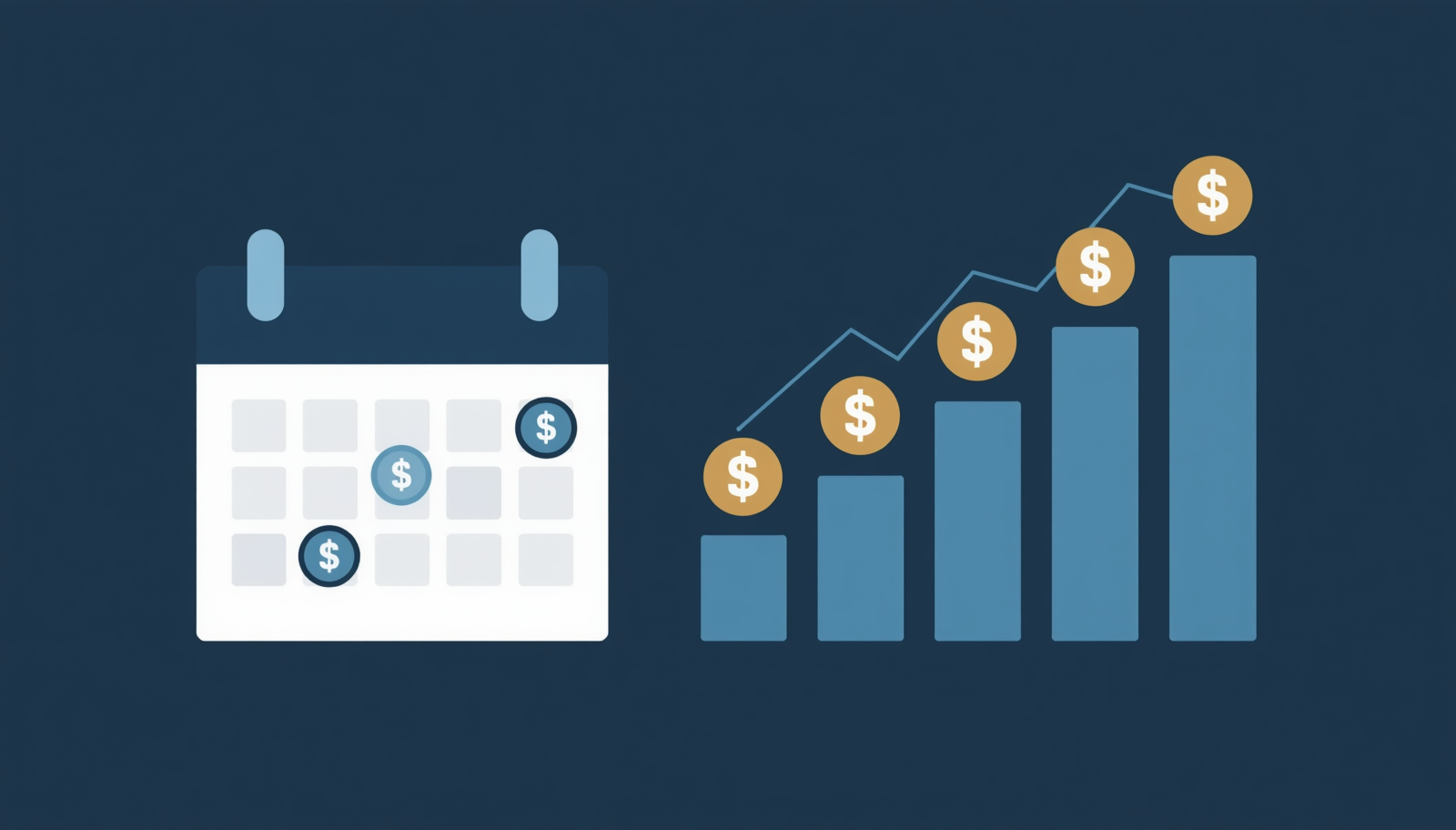
When you invest a fixed dollar amount regularly, you automatically buy more shares when prices are low and fewer shares when prices are high. You don’t have to think about it. The math does it for you.
Here’s a simple example:
| Month | Investment | Share Price | Shares Bought |
|---|---|---|---|
| January | $300 | $30 | 10.0 |
| February | $300 | $20 | 15.0 |
| March | $300 | $25 | 12.0 |
| April | $300 | $15 | 20.0 |
| May | $300 | $30 | 10.0 |
| Total | $1,500 | — | 67.0 shares |
Average share price over those 5 months: $24. But your average cost per share: $1,500 ÷ 67 = $22.39.
You paid less per share than the average price — without doing anything except investing consistently. That’s the mechanical advantage of dollar-cost averaging. When prices drop, your fixed contribution buys more. When prices recover, those extra shares are worth more.
The market dip in April wasn’t a disaster. It was 20 shares at $15.
The Alternative — And Why It Usually Loses
The alternative to dollar-cost averaging is timing the market: waiting for the “right” moment to invest a lump sum.
Here’s the problem. Nobody — not professional fund managers, not Wall Street analysts, not financial advisors with decades of experience — can reliably predict short-term market movements. The data on this is overwhelming and consistent: the vast majority of actively managed funds underperform simple index funds over any 10–20 year period. The managers who beat the market one year rarely do it two years in a row.
If the professionals can’t time the market consistently, the idea that you can do it by watching financial news and waiting for a feeling of confidence is a losing bet.
The investor who tries to time the market faces two risks that the dollar-cost averager doesn’t: buying at the wrong time (market drops right after you invest) and waiting too long (market runs while you sit in cash). Both are expensive mistakes.
Think of it like this: trying to time the market is like deciding whether to show up to practice based on whether you feel like you’re going to have a great session. Some days you’ll be right. Most days you’ll have talked yourself out of work that would have compounded.
What DCA Looks Like in Practice
You don’t need a large upfront sum to start. You need a fixed amount and a schedule.
Step 1: Decide on a fixed contribution amount. It doesn’t need to be impressive. $50/month, $100/month, $300/month — pick a number that doesn’t require you to think about whether you can afford it each time. It should feel automatic.
Step 2: Pick your investment vehicle. For most people, this is a low-cost index fund inside a Roth IRA or a brokerage account. Something like VTSAX (Vanguard Total Stock Market Index Fund, expense ratio 0.04%) or VTI (the ETF equivalent). Broad market exposure, minimal fees, no stock-picking required.
Step 3: Set it up on autopilot. Every major brokerage — Fidelity, Vanguard, Schwab — lets you automate recurring investments. Set the date, set the amount, and let it run. The goal is to make it require zero willpower after the initial setup.
Step 4: Don’t check it constantly. This is harder than it sounds. The market will drop. Your balance will go down. The financial news will sound alarming. None of that is a signal to stop — it’s just noise. Your scheduled investment goes in regardless. That’s the discipline.
DCA During a Market Drop: The Mindset Shift
This is where most people fail — and where the athlete mindset becomes genuinely useful.
When markets drop, the emotional response is to stop investing. It feels wrong to put money in when everything is going down. But mathematically, a market drop is the best time to be on a dollar-cost averaging schedule — because your fixed contribution buys more shares at lower prices.
The athlete equivalent: showing up to training during the hard weeks. The weeks where nothing feels right, the reps are ugly, and progress seems invisible. Those sessions feel like a waste. They’re usually the ones that matter most — because you’re building the habit and the base that everything else runs on.
An investor who paused DCA contributions during the COVID crash in March 2020 and missed the subsequent recovery left significant gains on the table. The S&P 500 dropped about 34% in five weeks — and then recovered all of it within six months, going on to reach new highs. The investors who kept contributing on schedule through the drop bought shares at a significant discount and captured the entire recovery.
They didn’t time the market. They ignored it.
Who Dollar-Cost Averaging Is For
DCA is the right default strategy for almost anyone who isn’t a professional investor — which is nearly everyone reading this.
It’s especially well-suited for:
People early in their investing career. When you don’t have a large lump sum to invest, regular contributions are the only option anyway. DCA makes that a feature, not a limitation.
People with a regular paycheck. If money hits your account on the 1st and 15th, you can schedule contributions immediately after. The consistency of your income maps directly onto the consistency of the strategy.
People who don’t want to think about it. That’s most people — and it should be. The goal of investing isn’t to make it your hobby. It’s to build wealth in the background while you focus on your actual life. DCA is the strategy most compatible with not thinking about your investments constantly.
Athletes and former athletes. The mindset is already there — you understand what consistent effort over time produces. You’ve lived it in the weight room and on the field. DCA is just applying that same mindset to a brokerage account.
One Caveat Worth Knowing
Dollar-cost averaging isn’t always the mathematically optimal strategy when you have a large lump sum to invest.
Research from Vanguard found that lump sum investing — putting all available money in immediately — outperforms dollar-cost averaging roughly two-thirds of the time over 12-month periods, because markets tend to go up over time. If you receive a large inheritance or bonus, putting it all in immediately has historically been the better bet.
But here’s the practical reality: most people don’t have a large lump sum sitting in cash. They have a monthly paycheck and an investing habit. For that situation — which is the situation most people are actually in — dollar-cost averaging isn’t a compromise. It’s exactly the right tool.
And even when a lump sum is available, the psychological benefit of DCA matters. An investor who dollar-cost averages into a lump sum over 6–12 months sleeps better and is less likely to panic-sell during volatility than one who went all-in and watches the balance swing dramatically. The best strategy is the one you’ll actually stick with.
The Bottom Line
Dollar-cost averaging isn’t a sophisticated strategy. That’s the point.
It removes the decision, removes the emotion, and removes the temptation to wait for conditions that never feel quite right. You invest on schedule. You buy more when prices drop. You let time and compounding do the heavy lifting.
The athletes who improve the most aren’t the ones who train hardest on their best days. They’re the ones who show up on their worst days too — because they know the accumulation is the point, not any single session.
Your investment account works the same way.
Your next move: Log into your brokerage or Roth IRA account this week and set up an automatic recurring investment — whatever amount works for your budget right now. Even $50/month. Set the date, set the amount, and let it run. The automation is the strategy.
This article is for informational purposes only and does not constitute personalized financial advice. Consult a qualified professional for guidance specific to your situation.
Sources & Data
- Dollar-cost averaging vs. lump sum investing research: Vanguard — Dollar-Cost Averaging Just Means Taking Risk Later
- S&P 500 COVID recovery timeline: S&P Dow Jones Indices
- Active fund manager underperformance data: S&P SPIVA Scorecard — U.S. Active vs. Passive
- VTSAX expense ratio: Vanguard — Total Stock Market Index Fund
- Automated investing setup: Fidelity — Automatic Investments